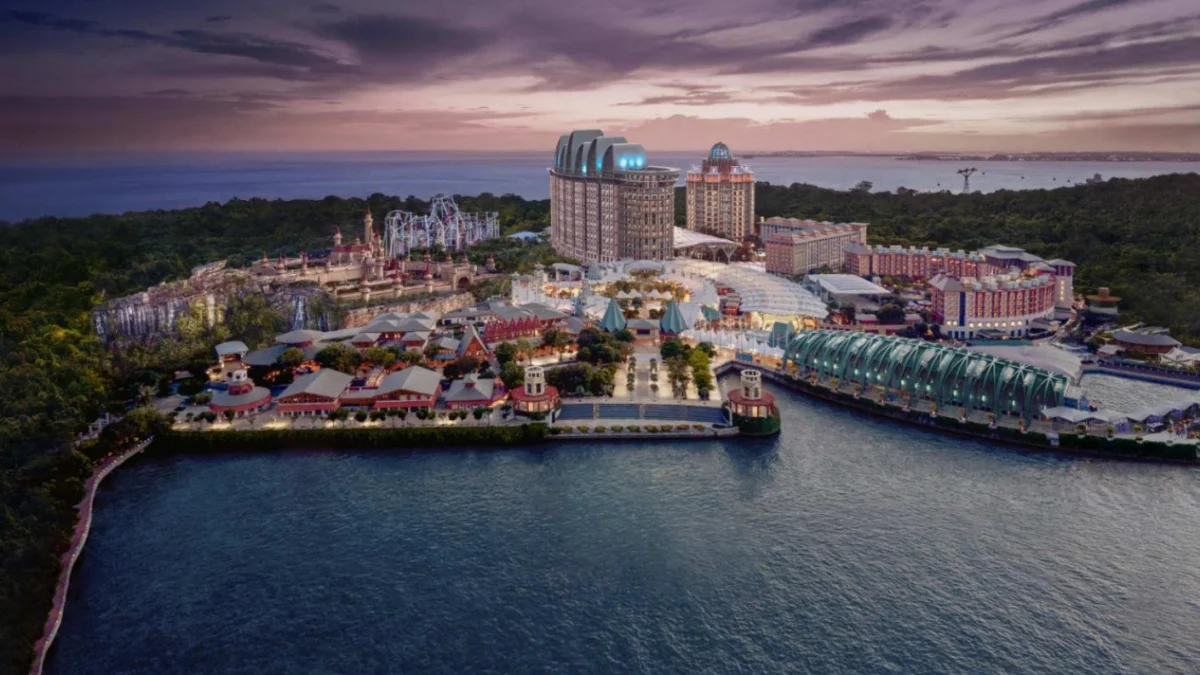
Resorts World Sentosa has partnered with Honeywell Technologies to introduce predictive optimisation for its district cooling system, becoming the first tourism destination in Singapore to adopt the technology.
The initiative builds on a 2023 connected-building deployment between the two companies, adding artificial intelligence and predictive capabilities aimed at supporting RWS’ carbon-neutrality ambition for 2030.
The companies will draw on the Honeywell Technologies Singapore Sustainable Buildings Centre of Excellence, established with support from the Singapore Economic Development Board, to develop and test the technologies within the resort.
Three programmes
The initiative includes three components. AI-driven adjustments to heating, ventilation and air-conditioning systems are already deployed at Resorts World Convention Centre and Illumination’s Minion Land at Universal Studios Singapore. The district cooling plant will be adapted to forecast cooling demand and determine which equipment should run and when, with the aim of avoiding excess production of chilled water. Honeywell Technologies’ Forge platform will also consolidate energy data across the resort to identify waste and generate recommendations for facilities teams.
Munish Suri, President, Building Automation, India and APAC, Honeywell Technologies, outlined the thinking behind the approach.
“The next frontier in building efficiency is not simply automating individual systems such as HVAC, chillers and district energy infrastructure,” said Suri. “It is enabling interconnected systems to work intelligently together, continuously and proactively optimising energy use as conditions change.”
Suri said the collaboration reflected how sustainability and operational performance could work together rather than compete.
“Resorts World Sentosa is demonstrating how sustainability and operational excellence can reinforce, rather than compete with, the guest experience,” said Suri. “By combining RWS’ deep operational expertise with Honeywell Technologies’ capabilities in AI, energy optimisation and intelligent buildings, our three co-innovation concepts are putting this vision into practice. This represents an important step in RWS’ journey from automation to autonomy.”
Guest comfort and efficiency
Kess Chiang, Senior Vice President, Resort Services, Resorts World Sentosa, described the role of facilities management in the project.
“Facilities management goes beyond fixing things when they break,” said Chiang. “It means staying ahead, using technology to make the resort more comfortable, reliable and efficient for every guest.”
Chiang gave an example of how temperature control could adapt automatically to changing conditions.
“A simple example is room and venue temperature,” said Chiang. “It should adjust itself to humidity, airflow and changing weather conditions, rather than rely on a fixed setting. The goal is that our guests should never feel too hot or too cold, while using only the energy that is needed.”